The Sales Framework That Will Help You Break Into Tech (Even Without a CS Degree)
By Tim O. | CareerPivoting.com | Updated February 2026
If you're applying to 200 jobs and getting ghosted, your problem isn't your resume. It's your discovery process.
Landing a tech role without a CS degree isn't a credentials game. It's a sales cycle. And right now, you're probably pitching a "solution" (yourself) before you've diagnosed the "problem" (the team's actual pain).
This guide gives you a system based on SPIN Selling, a framework used by top sales engineers and enterprise sellers to close complex deals. Adapted for career pivoters, it's designed to turn your non-traditional background from a liability into a specialized solution.
Stop applying. Start closing.
What Is SPIN Selling (And Why Does It Work for Job Seekers)?
SPIN was developed by Neil Rackham after studying over 35,000 sales calls. He found that the best salespeople didn't pitch. They asked smart questions that helped buyers realize they needed to act.
SPIN stands for four types of questions: Situation, Problem, Implication, and Need-Payoff. Replace "buyer" with "hiring manager" and "solution" with "you," and you have a system for every networking call, informational interview, and job interview you'll ever walk into.
The core principle is simple: stop pitching, start diagnosing.
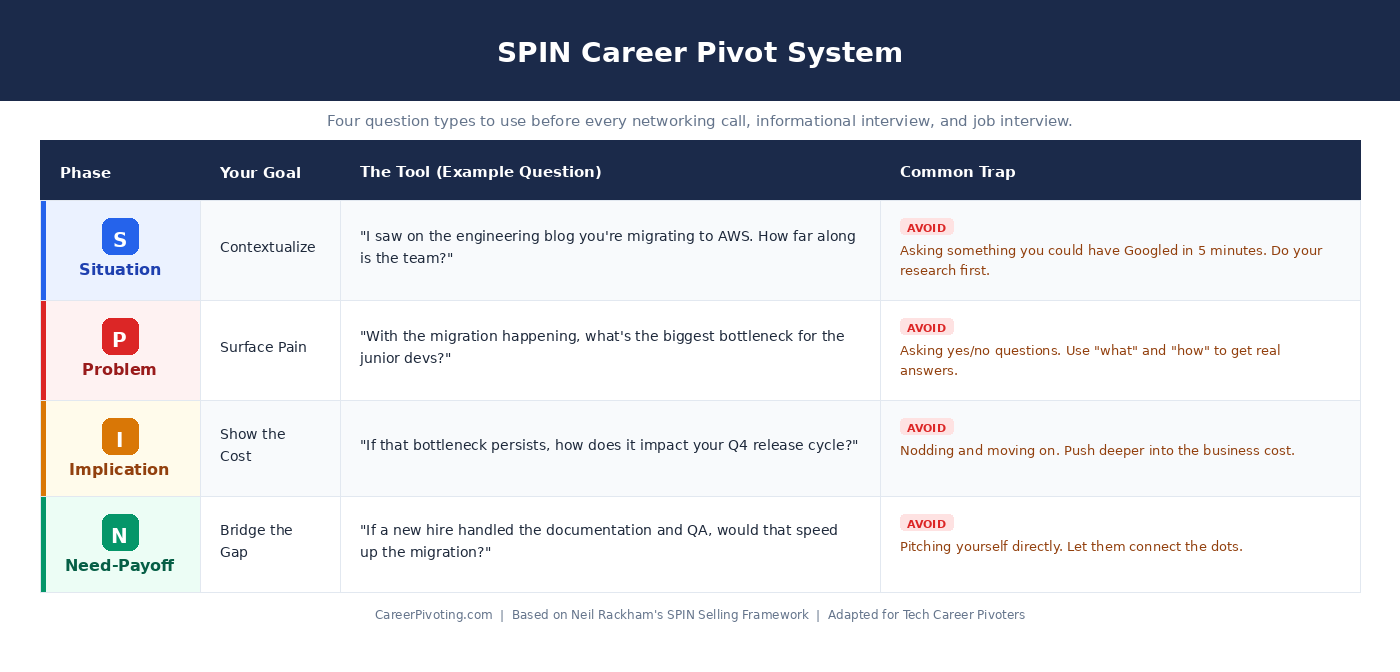
The SPIN Career Pivot System: Your Reference Table
Bookmark this. Use it before every conversation.
| Phase | Your Goal | The Tool (Example Question) | Common Trap |
|---|---|---|---|
| Situation | Contextualize | "I saw on the engineering blog you're migrating to AWS. How far along is the team?" | Asking something you could have Googled in 5 minutes. Do your research first. |
| Problem | Surface Pain | "With the migration happening, what's the biggest bottleneck for the junior devs?" | Asking yes/no questions. Use "what" and "how" to get real answers. |
| Implication | Show the Cost | "If that bottleneck persists, how does it impact your Q4 release cycle?" | Nodding and moving on. Push deeper into the business cost. |
| Need-Payoff | Bridge the Gap | "If a new hire handled the documentation and QA, would that speed up the migration?" | Pitching yourself directly. Let them connect the dots. |
That's the system. Four phases. Four question types. Every conversation you have from this point forward should follow this structure.
Want this table as a printable worksheet? Download free.
Now let's break down how to actually use each one.
Situation: Do Your Homework Before the Conversation
Before any informational interview, networking call, or actual job interview, you need to understand the landscape. What does this company do? What tech stack are they using? What challenges does their industry face right now?
This is where career pivoters mess up. They walk into conversations asking basic questions they could have Googled in five minutes. That signals laziness, not curiosity.
Instead, come prepared with context. If you're targeting a DevOps role at a fintech company, know that they're probably dealing with compliance requirements, deployment speed pressures, and security concerns. You don't need to be an expert. You need to show you've done the work.
Pro Tip: Before your next informational interview, spend 20 minutes on the company's engineering blog, recent job postings, and LinkedIn profiles of people on the team. Walk in with context, not blank stares. Your Situation questions should prove you already know the basics, so the conversation can go deeper immediately.
Problem: Ask Questions That Make People Think
Here's where SPIN gets powerful for career pivoters. Most people in networking conversations ask surface-level questions like "What do you do?" or "How did you get into tech?" Those are fine, but they don't create connection.
Problem questions dig deeper. They get the other person talking about what's actually hard about their work. And when someone shares their frustrations with you, something shifts. You go from stranger to someone who understands.
Questions like:
- "What's the most frustrating part of onboarding new team members right now?"
- "Where do you see the biggest skill gaps on your team?"
- "What keeps breaking that you wish someone would just fix?"
These questions do two things. First, they give you real intelligence about what the team actually needs (not what the job description says). Second, they position you as someone who thinks about solving problems, not just filling a seat.
I coached a former high school teacher who used this approach during informational interviews with engineering managers. She'd ask about their team's documentation gaps and knowledge-sharing challenges. Guess what? Those were problems she'd spent 10 years solving in a classroom. She landed a technical writer role within three months because she understood the pain before she ever pitched herself.
Pro Tip: Job descriptions are wish lists written by committees. The real needs live in the conversations you have with people on the team. Your Problem questions are how you find them.
Implication: Help Them Build the Business Case to Hire You
This is the step most people skip entirely. Once someone shares a problem, don't just nod and move on. Help them think about what that problem is actually costing them.
- "If onboarding takes three months instead of one, how does that affect your team's velocity?"
- "When those manual processes break, what does that mean for your on-call engineers?"
- "If that skill gap stays unfilled for another quarter, what happens to your roadmap?"
Here's what's really happening in this phase. You are helping the hiring manager build the business case for their own boss to approve the hire. Most managers know they need help, but they struggle to quantify it. When you help them connect a problem to a business cost (missed deadlines, burned-out engineers, slipped releases), you're giving them the ammunition to push the req through.
This works especially well for career pivoters because it shifts the conversation away from "do you have the right pedigree?" and toward "do you understand our problems well enough to help solve them?"
Pro Tip: Implication questions work best when they connect to numbers, timelines, or team morale. "How does that affect your Q4 goals?" is stronger than "Is that a problem?" The more specific the cost, the more urgent the hire feels.
Need-Payoff: Let Them See You in the Role
The final step is the most elegant. Instead of saying "I can do that," you ask questions that let the other person picture you solving their problem.
- "If someone came in with strong project management experience and could own that onboarding process, would that free up your senior engineers?"
- "Would it help to have someone on the team who's built training programs before?"
- "If you had someone who could bridge the gap between your technical team and your business stakeholders, what would that unlock?"
Notice you're not saying "hire me." You're letting them connect the dots. That's infinitely more powerful than a pitch, because people trust conclusions they reach themselves far more than conclusions you hand them.
A client of mine was a former HR manager trying to break into tech recruiting. During interviews, instead of defending why she didn't have "tech recruiting experience," she'd ask: "If you had someone who understands compliance, candidate experience design, and process optimization, how would that change your hiring pipeline?" Every interviewer started nodding. She got three offers.
Pro Tip: Need-Payoff questions should describe capabilities, not job titles. "Someone who can build documentation systems" hits harder than "a technical writer." Let the manager map your skills to their problem in their own words.
Why This Works for Non-Traditional Backgrounds
SPIN works because it flips the script on how most career pivoters approach the job search. Instead of begging for a chance, you're running a discovery process. Instead of defending your background, you're surfacing problems that your unique experience is built to solve.
The hiring managers you're talking to are often bad at articulating what they actually need. When you use SPIN, you uncover those real needs. And when someone realizes you understand their problems better than the candidates with "perfect" resumes, your non-traditional background stops being a liability. It becomes your edge.
The teacher who understands how to break down complexity becomes the technical writer who can actually make docs useful. The HR manager who redesigned hiring workflows becomes the recruiting operations lead who fixes broken pipelines. The retail manager who ran a team of 30 becomes the project manager who keeps engineering on track.
You already have the transferable skills. SPIN gives you the language to prove it.
Your 5-Day Action Plan
This is where reading stops and doing starts. Block 30 minutes each day this week.
Day 1: Research
Pick one company you're targeting. Spend 30 minutes on their engineering blog, recent job postings, and team LinkedIn profiles. Write down three Situation insights you'd bring into a conversation.
Day 2: Problem questions
Draft five Problem questions specific to that company or role. Make them open-ended. Make them specific enough to show you did your homework.
Day 3: Implication follow-ups
For each Problem question, write one Implication follow-up that connects to a business cost (time, money, morale, deadlines). Practice saying them out loud so they sound natural, not rehearsed.
Day 4: Need-Payoff bridges
Write three Need-Payoff questions that connect your existing skills to the problems you've identified. Don't mention your job title. Focus on capabilities.
Day 5: Go live
Reach out to someone at that company for an informational interview. Use your SPIN questions. Take notes on what you learn.
You're not just looking for a job. You're running a discovery process. And the people who run the best discovery are the ones who get hired.
The 30-Second SPIN Interview Checklist
Glance at this before you walk into any conversation.
If you checked all five, you're more prepared than 95% of candidates.
Download the SPIN Interview Prep Worksheet
Want the full system?
I've built a SPIN Interview Prep Worksheet with question templates for 5 common tech roles (DevOps, QA, Technical Writing, Project Management, and Customer Success). It walks you through building your SPIN questions step by step for any company you're targeting.
Download the Free Worksheet →Ready to build your full career pivot strategy? Visit CareerPivoting.com → for more frameworks, guides, and coaching designed to help you land your first role in tech without a CS degree.
Last updated: February 2026