The Software Engineer's 2026 Exit Strategy: 7 Non-Coding Roles Paying Over $200K
You didn't spend years learning to code just to hate opening your IDE every morning.
If you're a software engineer googling "how to leave coding" at 11pm, you're not alone. The 2024-2025 tech layoffs, the rise of AI coding assistants, and plain old burnout have created a mass exodus of developers looking for the exit.
The good news: your engineering background is a golden ticket to roles that pay more, stress less, and don't require you to ship code ever again.
Here are 7 non-coding roles where former software engineers are earning $200K+ in 2026.
Key Takeaway: Software engineers can transition to non-coding roles like Solutions Architect ($180K-$280K), AI Product Manager ($175K-$300K), or Technical Program Manager ($170K-$260K) in 3-12 months. These roles leverage engineering experience for design, strategy, and leadership rather than implementation. The highest-paying pivots in 2026 target AI governance and enterprise sales engineering, where technical credibility commands premium compensation.
What Are the Best Non-Coding Roles for Software Engineers?
| Role | Salary Range (2026) | Coding Required | Time to Pivot |
|---|---|---|---|
| Solutions Architect | $180K - $280K | None (design only) | 3-6 months |
| AI Product Manager | $175K - $300K | None | 6-12 months |
| Technical Program Manager | $170K - $260K | None | 3-6 months |
| AI Operations & Governance | $160K - $250K | Minimal | 6-9 months |
| Developer Relations | $150K - $220K | Light demos only | 3-6 months |
| Technical Recruiting | $140K - $280K (with commission) | None | 1-3 months |
| Sales Engineering | $160K - $300K (OTE) | Demo-level only | 3-6 months |
Why Engineers Are Leaving Coding in 2026
Three forces are pushing developers toward the exit:
1. AI Changed the Math
GitHub Copilot and Claude aren't replacing engineers yet, but they're changing what "engineering work" looks like. Junior tasks are automated. What's left is architecture, communication, and stakeholder management. If you wanted to do those things, you'd have become a PM.
2. The Comp Ceiling is Real
Staff Engineer pays well. But Principal? Distinguished? Those roles are political, rare, and require you to keep coding. Meanwhile, a mediocre Solutions Architect at a consulting firm clears $250K working 40 hours a week.
3. Burnout Isn't a Badge of Honor Anymore
The "10x engineer" myth is dead. Engineers are realizing that optimizing database queries at 2am doesn't make you a hero. It makes you tired.
Before you start, understand why most career pivots fail so you can avoid the common traps.
Is Solutions Architect a Good Career Pivot for Engineers?
Role: Solutions Architect
Salary Range: $180,000 - $280,000
Coding Required: None (you design, others build)
Time to Pivot: 3-6 months
What You'll Actually Do
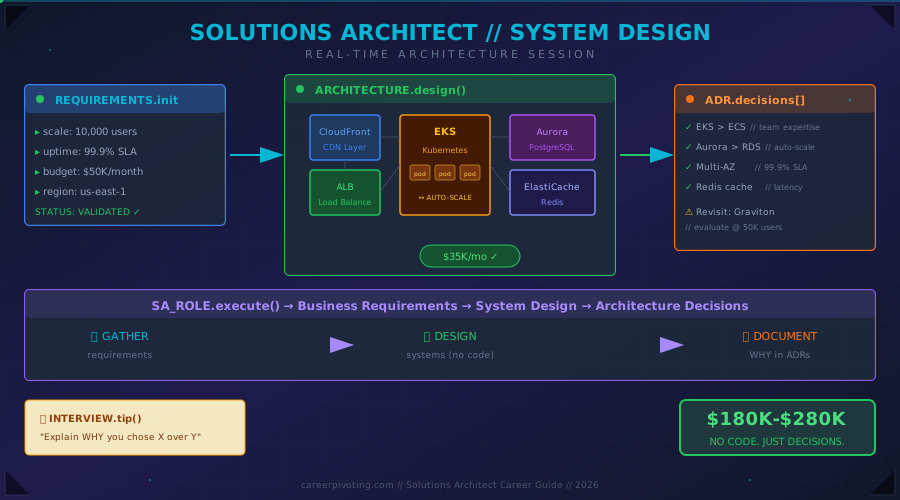
Solutions Architects are the translators between business requirements and technical implementation. You'll whiteboard systems, write architecture documents, and present to stakeholders. You won't write production code.
A typical week includes:
- Leading design reviews
- Creating architecture decision records (ADRs)
- Meeting with customers to understand requirements
- Evaluating build vs. buy decisions
- Mentoring engineering teams (without coding yourself)
Why Engineers Excel Here
Your coding background means you can smell bad architecture from a mile away. You know what's actually hard to build versus what sounds hard. That credibility is worth six figures.
How to Make the Pivot
- Start documenting architecture decisions now (even in your current role)
- Get AWS Solutions Architect Associate certification ($150, 2-3 weeks of study)
- Build a portfolio project with Architecture Decision Records
- Target "Customer-Facing SA" roles at cloud vendors or SaaS companies
"I realized I add more value designing systems than implementing them. In my last role, I led the architecture for [project], and I want to do that full-time."
For more on salary, credentials, and portfolio ideas, see our Solutions Architect guide.
Companies hiring SAs in 2026: AWS, Google Cloud, Snowflake, Databricks, HashiCorp, Datadog
Can Engineers Become AI Product Managers Without an MBA?
Role: AI Product Manager
Salary Range: $175,000 - $300,000
Coding Required: None
Time to Pivot: 6-12 months
What You'll Actually Do
AI Product Managers own the roadmap for AI/ML features. You don't train models. You decide what models should do, gather requirements, and work with ML engineers to ship products users actually want.
76% of product leaders are expanding AI investment in 2026. They need PMs who understand the technology without needing to implement it.
Why Engineers Excel Here
Most PMs can't read a model card or understand why a feature request is technically impossible. You can. That makes you the adult in the room during AI product planning.
How to Make the Pivot
- Take Reforge's AI for Product Managers course (or similar)
- Start writing PRDs for AI features in your current role
- Learn the AI product lifecycle (data collection, training, evaluation, deployment, monitoring)
- Target "Technical PM" or "AI PM" roles (they explicitly want engineering backgrounds)
"I've shipped AI features as an engineer, but I want to own the 'what' and 'why,' not just the 'how.' I understand model limitations, data requirements, and can translate between ML teams and stakeholders."
See our Product Manager role guide for the full playbook.
Companies hiring AI PMs in 2026: OpenAI, Anthropic, Google, Microsoft, Scale AI, Cohere
What Does a Technical Program Manager Actually Do?
Role: Technical Program Manager (TPM)
Salary Range: $170,000 - $260,000
Coding Required: None
Time to Pivot: 3-6 months
What You'll Actually Do
TPMs are the air traffic controllers of engineering organizations. You coordinate complex projects across multiple teams, manage dependencies, and make sure things ship on time. You run meetings, not deploys.
Why Engineers Excel Here
You've been on the receiving end of bad project management. You know what engineers actually need: clear requirements, realistic timelines, and someone who removes blockers instead of creating them.
How to Make the Pivot
- Volunteer to lead a cross-team project in your current role
- Get PMP or Agile certification (optional but helps)
- Build a portfolio of project documentation (timelines, risk registers, status reports)
- Target TPM roles at big tech (Amazon, Google, Meta all have massive TPM orgs)
"I've been the engineer frustrated by bad program management. I want to be the TPM I wish I'd had: technically credible, focused on unblocking teams, and allergic to unnecessary meetings."
Companies hiring TPMs in 2026: Amazon, Google, Meta, Apple, Netflix
What Is AI Operations and Why Is It Booming in 2026?
Role: AI Operations & Governance Specialist
Salary Range: $160,000 - $250,000
Coding Required: Minimal (scripting for automation)
Time to Pivot: 6-9 months
What You'll Actually Do
This is the fastest-growing non-coding role in tech. AI Ops specialists manage the lifecycle of AI systems: monitoring model drift, ensuring compliance, managing AI risk, and coordinating responsible AI practices.
Job titles vary: AI Operations Manager, AI Governance Lead, ML Platform Manager, Responsible AI Specialist.
Why This Role Is Exploding in 2026
Three regulatory forces are creating massive demand:
1. EU AI Act (effective August 2025): Companies deploying AI in Europe must classify systems by risk level, maintain documentation, and conduct conformity assessments. Someone has to operationalize this.
2. NIST AI Risk Management Framework: The US federal government now requires NIST AI RMF compliance for contractors. Private companies are adopting it as a best practice.
3. State-level AI laws: Colorado, California, and Illinois have passed AI transparency laws. More states are following in 2026.
Every Fortune 500 company needs AI governance specialists. There aren't enough of them.
How to Make the Pivot
- Study AI governance frameworks (NIST AI RMF, EU AI Act, ISO 42001)
- Get familiar with MLOps tools (MLflow, Weights & Biases, SageMaker)
- Target regulated industries (finance, healthcare, government) where AI governance is mandatory
- Position yourself as "technical + compliance" (rare combination)
"AI governance needs people who understand the technology, not just the policy. I can bridge ML engineering and compliance, translating regulatory requirements into technical controls."
Companies hiring AI Ops in 2026: JPMorgan, Goldman Sachs, UnitedHealth, Deloitte, IBM
Is Developer Relations a Real Career or Just Conference Travel?
Role: Developer Relations (DevRel)
Salary Range: $150,000 - $220,000
Coding Required: Light (demos and sample code only)
Time to Pivot: 3-6 months
What You'll Actually Do
DevRel professionals are the face of developer tools. You'll write tutorials, give conference talks, create demo apps, and gather feedback from the developer community. You code, but only for teaching purposes.
How to Make the Pivot
- Start creating content now (blog posts, YouTube tutorials, conference talks)
- Build a public presence on Twitter/X, LinkedIn, or YouTube
- Contribute to open source (shows community involvement)
- Target developer tools companies (they value authentic engineering voices)
"I love explaining technical concepts more than implementing them. I've been creating content on [platform], and I want to do this full-time for a product I believe in."
Companies hiring DevRel in 2026: Vercel, Supabase, PlanetScale, Clerk, Resend, Neon
Can Technical Recruiters Really Make $280K?
Role: Technical Recruiting
Salary Range: $140,000 - $280,000 (with commission)
Coding Required: None
Time to Pivot: 1-3 months
What You'll Actually Do
Technical recruiters find and close engineering candidates. The best ones are former engineers who can actually evaluate technical skills and sell candidates on opportunities.
The math is simple: place 4-5 senior engineers per year at $300K salaries, earn 20-25% commission. That's $240K-$375K.
How to Make the Pivot
- Join an agency first (learn the craft before going independent)
- Specialize in a niche (AI/ML, platform engineering, security)
- Build a network of engineering contacts (your future candidates and clients)
- Consider internal recruiting at big tech (lower comp ceiling but stable)
"I've been the candidate frustrated by recruiters who don't understand the role. I want to be the recruiter I wish I'd worked with: technically credible and focused on fit, not just filling seats."
See our Technical Recruiter guide for the full path.
Companies hiring technical recruiters in 2026: Karat, TripleByte, big tech internal recruiting, specialized agencies
What's the Difference Between Sales Engineering and Selling Out?
Role: Sales Engineering
Salary Range: $160,000 - $300,000 (OTE)
Coding Required: Demo-level only
Time to Pivot: 3-6 months
What You'll Actually Do
Sales Engineers (also called Solutions Engineers or Pre-Sales Engineers) are the technical half of enterprise sales. You do demos, answer technical questions, run POCs, and help close deals. You don't carry a quota, but you're tied to revenue.
How to Make the Pivot
- Target companies whose product you genuinely love (authenticity matters in sales)
- Practice giving demos (record yourself, get feedback)
- Learn basic sales methodology (MEDDIC, Challenger, etc.)
- Be comfortable with comp tied to revenue (OTE = On Target Earnings)
"I've been the engineer on the buying side, and I know what technical evaluators actually care about. I want to be the SE who helps customers solve real problems, not just close deals."
Companies hiring SEs in 2026: Snowflake, Databricks, Confluent, MongoDB, Elastic, CrowdStrike
How to Choose Your Exit Path
- Fastest pivot: Technical Recruiting (1-3 months) or TPM (3-6 months)
- Highest ceiling: AI Product Manager ($300K+) or Sales Engineering ($300K+ OTE)
- Stay technical-adjacent: Solutions Architect or AI Operations
- Extrovert: Developer Relations or Sales Engineering
- Introvert: Solutions Architect or AI Operations
The 90-Day Exit Plan
This plan follows our 4-Phase Career Pivot System. Before starting, read why most career pivots fail.
Days 1-30: Research & Position
- Pick your target role from this list
- Update LinkedIn headline to signal the pivot
- Identify 10 companies hiring for that role
- Start building your portfolio/credentials
Days 31-60: Build Proof
- Complete relevant certification (if applicable)
- Create 1-2 portfolio pieces that demonstrate the new skill
- Start networking with people in the target role
- Apply to 5 "stretch" roles to practice interviewing
Days 61-90: Execute
- Apply to 20+ targeted roles
- Leverage referrals (referrals > applications)
- Negotiate offers (you have leverage as a former engineer)
- Give notice and never open your IDE again
The Bottom Line
You became a software engineer because you're smart and like solving problems. Those skills don't disappear when you stop coding.
The roles in this guide pay as well (or better) than senior engineering, require fewer hours, and don't involve debugging production at 3am.
Your engineering background isn't a limitation. It's a competitive advantage in every one of these roles.
Pick one. Start today.
Frequently Asked Questions
Can I really make $200K without coding?
Yes. Solutions Architects at AWS, Snowflake, and Databricks regularly earn $200K-$280K base salary with no coding required. Sales Engineers at enterprise software companies earn $250K-$300K OTE (on-target earnings). These roles value your engineering background for design and communication, not implementation.
What is the fastest non-coding pivot for software engineers?
Technical Recruiting is the fastest pivot (1-3 months). You can leverage your engineering background immediately to evaluate candidates and understand technical requirements. The tradeoff is that compensation is heavily commission-based until you build a track record.
Do I need an MBA to become a Product Manager?
No. Engineering backgrounds are increasingly preferred for AI Product Manager roles. Companies like Anthropic, OpenAI, and Google explicitly seek PMs who can understand technical constraints and communicate with ML engineers. Experience shipping products matters more than credentials.
What is AI Operations and Governance?
AI Operations and Governance is a new field focused on managing the lifecycle of AI systems in production. This includes monitoring model performance, ensuring regulatory compliance (EU AI Act, NIST AI RMF), managing AI risk, and implementing responsible AI practices. Demand is exploding in 2026 due to new regulations.
Which non-coding role has the highest salary ceiling?
Sales Engineering and AI Product Management have the highest ceilings ($300K+). Sales Engineering compensation includes base salary plus commission tied to deals closed. AI Product Managers at companies like OpenAI and Anthropic command premium salaries due to the specialized knowledge required.
Is Solutions Architect a good career for introverts?
Yes. While Solutions Architects do client-facing work, much of the role involves deep technical analysis, writing architecture documents, and designing systems. Internal SA roles at enterprises are more design-focused and require less presentation than customer-facing roles at cloud vendors.
How do I explain a career pivot in interviews?
Focus on what you're moving toward, not what you're leaving. Instead of "I'm burned out on coding," say "I realized I add more value designing systems and working with stakeholders than implementing code. I want to do that full-time." Emphasize how your engineering background makes you uniquely qualified.