5 Cybersecurity Careers That Don't Require Coding (And Pay $100K+)
By Tim O. | 10+ years in DevSecOps and enterprise security
You've heard cybersecurity has millions of unfilled jobs. You've also heard you need to know Python, Bash, and how to hack into things. That second part? Not entirely true.
The cybersecurity industry has a dirty secret: some of the highest-paying roles don't require you to write a single line of code. While pentesters and security engineers get all the attention, there's an entire ecosystem of non-technical security jobs that pay $100K+ and are desperate for talent.
Here are 5 cybersecurity careers where your communication skills, business acumen, and attention to detail matter more than your ability to script.
Quick Summary: Non-Coding Cybersecurity Roles
| Role | Salary Range (2026) | Coding Required | Best Background |
|---|---|---|---|
| GRC Analyst | $90K – $140K | None | Audit, compliance, legal |
| Security Awareness Manager | $95K – $130K | None | Training, HR, communications |
| Vendor Risk Analyst | $85K – $130K | None | Procurement, audit, operations |
| Cybersecurity Sales | $150K – $300K OTE | None | Sales, account management |
| Privacy Analyst | $100K – $160K | None | Legal, compliance, policy |
Salary data sourced from Glassdoor, Levels.fyi, and Radford compensation surveys (January 2026). Ranges reflect US market; adjust ±20% for location.
Who This Guide Is NOT For
Before you read further, let's be clear about who should look elsewhere:
- If you want to hack things → This guide isn't for you. Look into penetration testing, red teaming, or security engineering instead.
- If you want to write security tools → You need a technical path. Consider security engineering or DevSecOps roles.
- If you hate documentation and meetings → GRC, privacy, and vendor risk are heavily documentation-focused. These roles may frustrate you.
- If you want 100% remote with zero human interaction → Most of these roles require significant stakeholder communication.
- If you're looking for entry-level roles under $70K → These are mid-level positions. Consider IT Help Desk or SOC Analyst Tier 1 as stepping stones.
This guide IS for: Career changers who want to work in cybersecurity, earn $100K+, and leverage soft skills like communication, organization, compliance expertise, and business acumen rather than coding ability.
The Soft Skills That Actually Matter
Technical security teams have plenty of people who can write code. What they lack are people who can:
| Soft Skill | Why It Matters | Which Roles Need It Most |
|---|---|---|
| Written Communication | Policies, reports, and documentation must be clear | GRC, Privacy, Vendor Risk |
| Verbal Communication | Translating security to executives and employees | Security Awareness, Sales |
| Attention to Detail | Compliance gaps hide in the details | GRC, Vendor Risk, Privacy |
| Project Management | Security initiatives need coordination | All roles |
| Stakeholder Management | Security touches every department | All roles |
| Negotiation | Vendor contracts, remediation timelines, deals | Vendor Risk, Sales |
| Training & Facilitation | Changing employee behavior requires teaching skills | Security Awareness |
If you're strong in these areas, you're already more qualified than you think.
How Non-Technical Roles Fit the Security Ecosystem
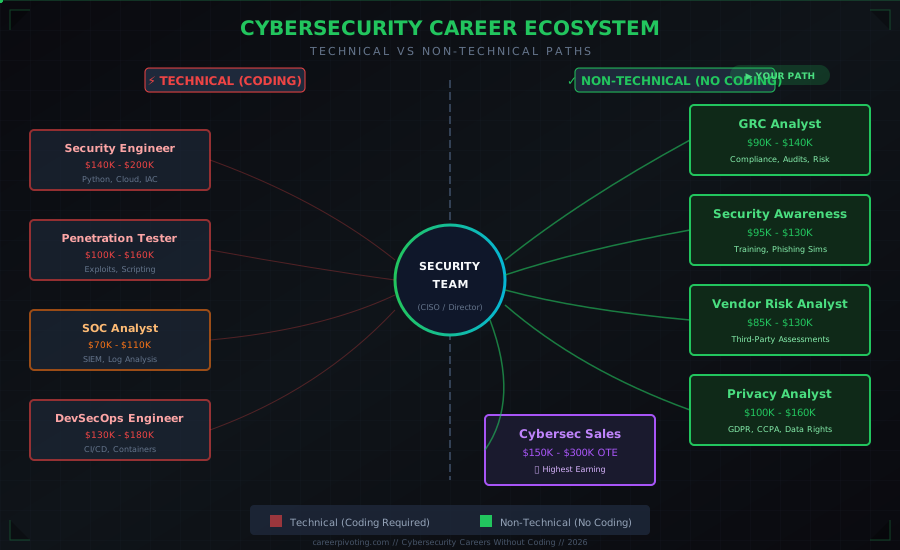
The diagram above shows how security teams actually work. Technical roles (left) handle threat detection, penetration testing, and infrastructure security. Non-technical roles (right) handle everything else: compliance, training, vendor management, privacy, and revenue. Both sides are essential. Neither can function without the other.
Why Non-Technical Security Roles Exist
Every company with data needs security. But here's what most people miss: security is mostly a people and process problem, not a technical one.
- 88% of data breaches involve human error (phishing, misconfigurations, weak passwords)
- Regulations like GDPR, CCPA, HIPAA, and SOC 2 require compliance expertise, not coding
- Vendors need to be assessed for security risk before contracts are signed
- Executives need security concepts translated into business language
Technical security teams are overwhelmed. They need people who can handle governance, training, compliance, and communication so they can focus on the technical work. That's where you come in.
Role 1: GRC Analyst (Governance, Risk & Compliance)
Salary Range: $90,000 – $140,000 | Coding Required: None | Time to Pivot: 3–6 months | Certifications: CISA, CRISC, or Security+ (helpful but not required to start)
What You'll Actually Do
GRC Analysts are the compliance backbone of security teams. You ensure the company follows security frameworks, passes audits, and manages risk appropriately. A typical week includes:
- Reviewing security policies and updating documentation
- Preparing evidence for SOC 2 or ISO 27001 audits
- Conducting risk assessments on new projects or vendors
- Mapping controls to compliance frameworks
- Meeting with department heads to assess compliance gaps
- Tracking remediation of audit findings
You'll spend most of your time in spreadsheets, documents, and meetings. Not in terminals.
Why This Role Exists
Regulations are multiplying. SOC 2, ISO 27001, HIPAA, PCI-DSS, GDPR, CCPA, NIST CSF, FedRAMP… every company needs someone who understands these frameworks and can prove compliance. Technical security teams don't have time (or interest) to manage audit evidence and policy documents.

Who Thrives Here
- Former auditors (Big 4, internal audit)
- Compliance professionals from finance or healthcare
- Project managers with attention to detail
- Legal or paralegal backgrounds
- Anyone who loves checklists and documentation
How to Break In
- Learn one framework deeply — Start with SOC 2 or ISO 27001 (most common)
- Get Security+ certified — $400, validates baseline security knowledge
- Study the NIST Cybersecurity Framework — Free, widely adopted
- Target "GRC Analyst" or "IT Compliance Analyst" roles — Entry-level titles
- Highlight transferable skills — Audit experience, policy writing, risk assessment
Companies hiring GRC Analysts: Deloitte, KPMG, PwC (consulting), plus every mid-size tech company, healthcare org, and financial institution.
Want the full breakdown? Read our complete GRC Analyst career guide.
Role 2: Security Awareness Manager
Salary Range: $95,000 – $130,000 | Coding Required: None | Time to Pivot: 2–4 months | Certifications: None required (Security+ helpful)
What You'll Actually Do
Security Awareness Managers turn employees from the weakest link into the first line of defense. You design and run programs that teach people to spot phishing, use strong passwords, and follow security policies. A typical week includes:
- Designing phishing simulation campaigns
- Creating training content (videos, newsletters, posters)
- Analyzing metrics (click rates, reporting rates, training completion)
- Running security awareness events (Cybersecurity Awareness Month, lunch-and-learns)
- Working with HR on onboarding security training
- Reporting program effectiveness to leadership
This is a communications and education role that happens to be in security.
Why This Role Exists
Phishing is still the #1 attack vector. Companies spend millions on firewalls and endpoint protection, then get breached because someone clicked a link. Security Awareness Managers reduce that human risk through training and culture change. The role has exploded because cyber insurance now requires security awareness programs, regulations mandate employee training, remote work increased phishing susceptibility, and executives finally understand that technology alone won't save them.
Who Thrives Here
- Corporate trainers and L&D professionals
- Internal communications specialists
- HR professionals
- Marketing/content creators
- Teachers transitioning to corporate roles
How to Break In
- Get familiar with awareness platforms — KnowBe4, Proofpoint, Cofense (watch their demos)
- Learn phishing fundamentals — Understand how attacks work (no coding needed)
- Build a sample campaign — Create a mock phishing simulation plan as a portfolio piece
- Target "Security Awareness" or "Security Training" roles — Often listed under IT or Security
- Emphasize metrics — Show you can measure behavior change, not just completion rates
Companies hiring Security Awareness Managers: Large enterprises, healthcare systems, financial services, managed security providers.
Role 3: Vendor Risk Analyst (Third-Party Risk Management)
Salary Range: $85,000 – $130,000 | Coding Required: None | Time to Pivot: 3–6 months | Certifications: CTPRP or CRISC (helpful)
What You'll Actually Do
Vendor Risk Analysts assess whether the companies you do business with are secure. Before your company shares data with a SaaS vendor, cloud provider, or contractor, someone needs to evaluate their security posture. A typical week includes:
- Reviewing vendor security questionnaires (SIG, CAIQ, custom)
- Analyzing SOC 2 reports and penetration test results
- Conducting vendor risk assessments and scoring
- Maintaining the approved vendor list
- Escalating high-risk vendors to security leadership
- Tracking vendor remediation of identified issues
You're essentially a security auditor focused on external partners rather than internal controls.
Why This Role Exists
The average enterprise uses 1,000+ SaaS applications. Each one is a potential entry point for attackers. Supply chain attacks (SolarWinds, MOVEit) proved that your security is only as strong as your vendors' security. Regulations now require formal third-party risk management: SOC 2 requires vendor management controls, GDPR requires data processor assessments, financial regulations mandate vendor due diligence, and cyber insurance questionnaires ask about TPRM programs.
Who Thrives Here
- Procurement and vendor management professionals
- Internal auditors
- Contract managers
- Operations professionals who review vendor agreements
- Anyone comfortable asking hard questions and reviewing documentation
How to Break In
- Learn to read a SOC 2 report — Understand Type I vs. Type II, control exceptions, and what to look for
- Study the SIG questionnaire — The Standardized Information Gathering questionnaire is industry standard
- Understand common frameworks — SOC 2, ISO 27001, NIST CSF at a high level
- Target "Vendor Risk," "Third-Party Risk," or "Supplier Security" roles
- Highlight your vendor management experience — Contract review, procurement, supplier relationships
Companies hiring Vendor Risk Analysts: Banks, insurance companies, healthcare systems, large tech companies, any company with extensive vendor ecosystems.
Role 4: Cybersecurity Sales (Account Executive / Sales Engineer)
Salary Range: $150,000 – $300,000+ OTE | Coding Required: None | Time to Pivot: 3–6 months | Certifications: None required (vendor certs helpful)
What You'll Actually Do
Cybersecurity Sales professionals sell security products and services to enterprises—endpoint protection, SIEM platforms, penetration testing services, and more.
Account Executives (AEs) own the sales process: prospecting and qualifying leads, running discovery calls, coordinating demos with Sales Engineers, negotiating contracts and closing deals, managing customer relationships.
Sales Engineers (SEs) are the technical half: delivering product demos, answering technical questions, running proof-of-concept deployments, translating customer requirements to solutions, supporting AEs in complex deals. Neither role requires coding. SEs need to understand security concepts deeply, but you're demonstrating products, not building them.
Why This Role Pays So Well
Enterprise security deals are massive. A single contract can be worth $500K to $5M annually. When you're closing deals that size, companies pay accordingly. Base salary: $80K–$150K; commission: 50–100% of base at quota; top performers: $300K–$500K+ total comp. Security sales also has built-in demand. Every company needs security. Breaches make headlines weekly. Fear sells.
Who Thrives Here
- B2B sales professionals (especially enterprise SaaS)
- Account managers wanting higher comp
- Technical people who prefer talking to building
- Former IT professionals who understand buyer pain points
- Anyone competitive and comfortable with rejection
How to Break In
For Account Executive roles: Leverage existing sales experience; learn security fundamentals; target security vendors (CrowdStrike, Palo Alto, Zscaler, SentinelOne, Okta); start as BDR/SDR if needed.
For Sales Engineer roles: Get Security+ or vendor certifications; learn one product deeply; practice demos; highlight customer-facing technical experience (support, consulting, implementation).
Companies hiring Cybersecurity Sales: CrowdStrike, Palo Alto Networks, Zscaler, Okta, SentinelOne, Fortinet, Cloudflare, Proofpoint, KnowBe4.
Role 5: Privacy Analyst
Salary Range: $100,000 – $160,000 | Coding Required: None | Time to Pivot: 4–8 months | Certifications: CIPP/US, CIPP/E, CIPM (IAPP certifications)
What You'll Actually Do
Privacy Analysts ensure companies handle personal data according to GDPR, CCPA, and HIPAA. While security focuses on protecting data from attackers, privacy focuses on using data ethically and legally. A typical week includes:
- Reviewing new features for privacy implications (Privacy Impact Assessments)
- Maintaining records of processing activities (ROPA)
- Responding to data subject access requests (DSARs)
- Updating privacy policies and notices
- Training employees on data handling requirements
- Working with legal on privacy-related contracts (DPAs)
Privacy sits at the intersection of legal, compliance, and technology. You're translating regulations into practical business guidance.
Why This Role Exists
Privacy regulations have teeth now: GDPR fines can reach 4% of global revenue (Meta was fined $1.3B in 2023); CCPA/CPRA gives California consumers extensive rights; new state laws (Virginia, Colorado, Connecticut, Utah) add complexity; AI regulations (EU AI Act) are creating new privacy requirements. Every company collecting customer data needs privacy expertise. That's essentially every company.
Who Thrives Here
- Paralegals and legal professionals
- Compliance professionals from any industry
- Policy analysts
- Detail-oriented people who enjoy regulatory interpretation
How to Break In
- Get IAPP certified — CIPP/US or CIPP/E is the gold standard ($550 exam)
- Learn GDPR and CCPA deeply — Understand rights, requirements, and enforcement
- Study Privacy Impact Assessments — Core skill for the role
- Target "Privacy Analyst," "Privacy Specialist," or "Data Protection" roles
- Highlight regulatory experience — Any compliance background transfers
Companies hiring Privacy Analysts: Tech companies (Meta, Google, Apple), healthcare, financial services, consulting firms, any company with significant customer data.
How to Choose Your Path
- Highest earning potential? → Cybersecurity Sales ($300K+ possible)
- Fastest pivot? → Security Awareness Manager (2–4 months, leverages training/comms experience)
- Detail-oriented and love documentation? → GRC Analyst or Vendor Risk Analyst
- Legal or policy background? → Privacy Analyst
- Extrovert who likes variety? → Security Awareness Manager or Cybersecurity Sales
- Introvert who likes deep work? → GRC Analyst or Privacy Analyst
The 90-Day Pivot Plan
Days 1–30: Foundation
- Pick your target role from this list
- Study relevant framework (SOC 2, NIST CSF, GDPR depending on role)
- Get Security+ or role-specific certification started
- Follow security news (Krebs on Security, Dark Reading)
- Update LinkedIn headline to signal interest
Days 31–60: Build Credibility
- Complete certification exam
- Create portfolio piece (sample policy, awareness campaign plan, or risk assessment)
- Join relevant communities (ISACA, IAPP, local security groups)
- Network with people in target role
- Apply to 5 stretch roles for interview practice
Days 61–90: Execute
- Apply to 20+ targeted roles
- Leverage referrals over cold applications
- Tailor resume to emphasize transferable skills
- Prepare role-specific interview answers
- Negotiate offer (security roles have leverage in this market)
Frequently Asked Questions
Can I really break into cybersecurity without technical skills?
Yes. GRC, privacy, awareness, vendor risk, and sales roles exist specifically because technical security teams need support from people with different skill sets. The 3.5 million unfilled cybersecurity jobs aren't all for hackers.
Which certification should I get first?
For most non-technical roles, Security+ is the best starting point. It's vendor-neutral, widely recognized, and proves you understand security fundamentals. For privacy specifically, get CIPP instead.
Do I need a home lab or hands-on hacking experience?
Not for these roles. Home labs are valuable for technical positions (SOC Analyst, Pentester, Security Engineer). For GRC, privacy, awareness, and sales, your time is better spent learning frameworks and building soft skills.
What's the career path from these entry points?
| Entry Role | Mid-Level | Senior |
|---|---|---|
| GRC Analyst | GRC Manager | CISO, Chief Risk Officer |
| Security Awareness | Awareness Director | Security Culture Executive |
| Vendor Risk Analyst | TPRM Manager | Chief Third-Party Risk Officer |
| Cybersecurity Sales | Enterprise AE, SE Manager | VP Sales, CRO |
| Privacy Analyst | Privacy Manager | Chief Privacy Officer, DPO |
How do I compete with candidates who have security experience?
Emphasize transferable skills. An auditor who understands compliance is more valuable in a GRC role than a junior pentester. A corporate trainer who can change behavior is more valuable in awareness than a security engineer who can't communicate. Your "non-security" experience is often your advantage.
The Bottom Line
Cybersecurity isn't just for hackers. The industry desperately needs people who can navigate compliance frameworks, train employees to spot threats, assess vendor security posture, sell security solutions, and operationalize privacy regulations. These roles pay $100K+ and don't require you to write code, run exploits, or build home labs.
The 3.5 million unfilled cybersecurity jobs? Many of them are waiting for people exactly like you. Pick a role. Start today.
A Day in the Life: What These Roles Actually Look Like
Coming Soon: "A Day in the Life" video series featuring professionals in each of these roles.
Subscribe to get notified when we publish interviews with working GRC Analysts, Security Awareness Managers, and Privacy professionals.
| Role | Typical Day | Meeting Load | Document Load |
|---|---|---|---|
| GRC Analyst | Reviewing controls, preparing audit evidence, updating policies | 3–4 hours | Heavy |
| Security Awareness | Creating content, analyzing phishing metrics, running training | 2–3 hours | Medium |
| Vendor Risk | Reviewing SOC 2 reports, scoring vendors, chasing questionnaires | 2–4 hours | Heavy |
| Cybersecurity Sales | Discovery calls, demos, proposals, pipeline management | 5–6 hours | Light |
| Privacy Analyst | PIAs, DSAR responses, policy reviews, legal coordination | 3–4 hours | Heavy |
Your Next Step
Ready to Start Your Cybersecurity Career?
Take the free Career Quiz to confirm a non-technical security role is right for you. Or explore our complete guide to breaking into tech without coding.
Last updated: January 2026